
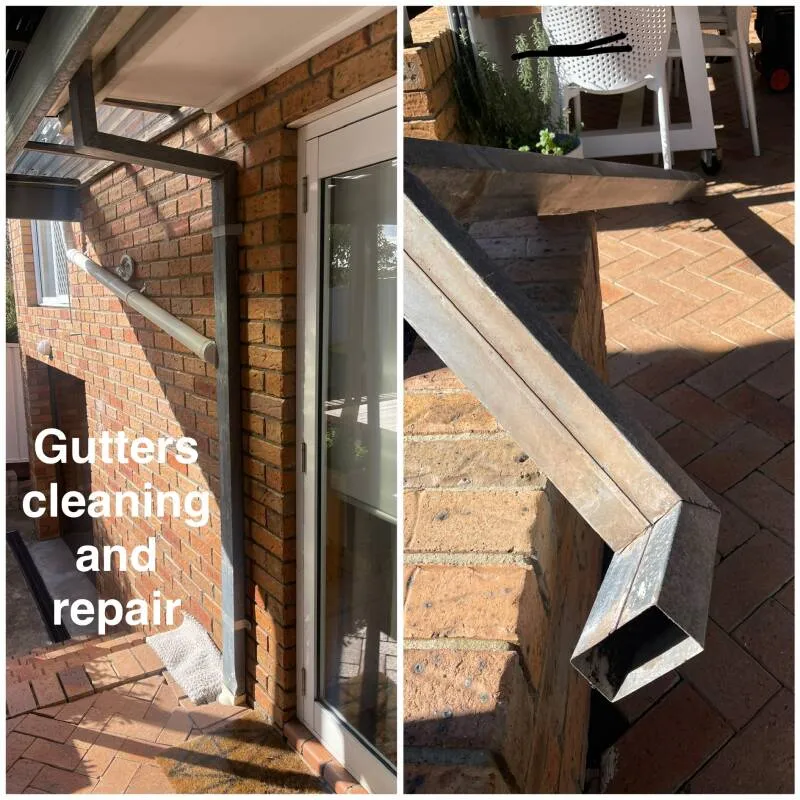
Canberra has two seasons that are tough on guttering, and they sit either side of winter. The autumn drop in late April fills everything that can be filled. Then the first proper frost lands in late May, and water that should drain freely sits in the gutter, freezes overnight, and pushes joints apart half a millimetre at a time.
By August half a gutter run is leaking at every join, the downpipe's blocked with leaf paste, and the fascia behind it is wetter than it should be. Most of that is preventable with a half-hour walk-around in May.
What goes wrong in a Canberra winter
The three pieces of the puzzle, in the order they fail:
- Autumn fills the gutter. Eucalypts drop bark and leaf in big bursts through April. A single mature gum near the house can fill a 20-metre gutter run in two weekends.
- Water sits where it shouldn't. Leaves block the flow to the downpipe, water pools, and the gutter starts holding 2–3kg per metre instead of draining. Brackets that were fine at install start pulling out of the fascia.
- The freeze finishes it. Pooled water expands as it freezes, prying joins apart. By the time it thaws there's a hairline leak at every junction, small enough not to notice, big enough to soak the fascia over four months.
WHY THIS MATTERS
A leaking gutter doesn't show up as a leak. It shows up six months later as a soft patch in the fascia board, peeling paint on the eave, and, in a few cases, water tracking inside the cavity and behind a wall. By that point you're not paying for a gutter clean. You're paying for a section of fascia, a paint touch-up and a wall repair.
Three signs you can see from the ground
You don't need a ladder to spot these. Stand in the yard, look up, and check for:
- A sag in the gutter line. If you sight along the gutter and it dips between brackets, water is pooling.
- Staining down the brick or render below a join. Vertical dark streaking under a gutter join is water that's already escaping. It's usually been doing so for months.
- Plant life in the gutter. If grass or a seedling is visible above the gutter line, you've got soil-grade compost in there. Time for a clean.
"If you can see anything green poking out of the gutter from the ground, the inside is worse than you think." , TEAM NOTE · POST-INSPECTION · WANNIASSA
The half-hour check worth doing in May
Late April through mid-May is the window. The leaves are mostly down, the frosts haven't started, and it's safe to be on a ladder. If you're comfortable on a stable ladder and the gutter's accessible, here's the order:
- Clear the gutter run by hand into a bucket, scoop, don't sweep. Bark and leaf turn into a peat-like mass after a wet week and will block the downpipe if you flush them in.
- Flush the gutter with a garden hose from the end furthest from the downpipe. Watch the flow, if water pools or backs up anywhere, that section needs releveling or the bracket needs re-fixing.
- Run the hose down each downpipe until you can hear it hit the stormwater outlet at ground level. No sound, no flow, there's a blockage somewhere in the pipe.
- Walk around the house and look at every gutter join from below. Joins that drip while the hose is running are leaking. Mark them with a piece of tape.
Half an hour, one bucket, one hose, one ladder. That's the whole check. The point isn't to do a perfect job, it's to find the leaks and blockages while they're cheap to fix.
SAFETY NOTE
Don't do this on a single-storey extension ladder leaning on the gutter itself. The gutter will bend, the ladder will slip, and you'll find out the hard way why most of our gutter call-outs start in June. Use a stable A-frame ladder set on flat ground, or ring someone.
Above single-storey height, don't do it at all. The fall isn't worth it.
When to stop and ring someone
Three calls. If any of these apply, don't try to DIY:
- The gutter is on a two-storey section, or the roof pitch makes ladder access dodgy. For two-storey, that call is to a gutter specialist with height equipment, as we only work on single-storey rooflines.
- You can see daylight through a gutter join, the gutter has visibly come away from the fascia, or there's a bracket missing.
- The downpipe is blocked solid, water doesn't move at all, even with the hose on full. That's usually a packed downpipe needing a snake or a section removed.
For everything else, a full clean, a re-flush, joint silicone touch-up, a bracket re-fix, downpipe clearing, book a standard gutter visit. That covers most Canberra single-storey homes.
A quick FAQ
How often should I clean gutters in Canberra?
Once a year if the property has no overhanging trees. Twice, once in May, once in November, if you've got gums, willows or large deciduous trees within 10 metres of the house. Strata properties usually need spring and autumn.
Do gutter guards mean I never need to clean?
No. They keep the bulk leaf out but trap fine debris on top of the mesh. The mesh still needs sweeping yearly, and the gutter underneath still needs a flush every second year. Good guards extend the interval, they don't replace the job.
What does a gutter clean cost in Canberra?
We quote a firm fixed price before starting. A typical single-storey home with clear access and no major repair is a 90-minute to two-hour job including a downpipe flush. We only take on single-storey gutters, so for a two-storey roofline we will point you to someone set up for height work. There are no surprises on the invoice.
Can I just claim it under home insurance later?
Most home policies treat gutter damage from leaves and lack of maintenance as not covered. Storm-driven debris is sometimes covered, but the assessor will ask when you last had them cleaned. A dated receipt for a gutter clean is cheap insurance for the insurance.
Got a gutter on the list? Ring 0424 705 056 and we'll book you in, ideally before the first frost. Free fixed quote on the phone.